Justice is out of reach for too many Americans. We're finding solutions.

Eviction in Maricopa County, AZ

Access to Justice is:

Low income tenants with access to legal representation can avoid eviction and hold abusive landlords accountable.

Many people need legal help to divorce on equitable terms, to get protection from abusive spouses- or to keep their families together.
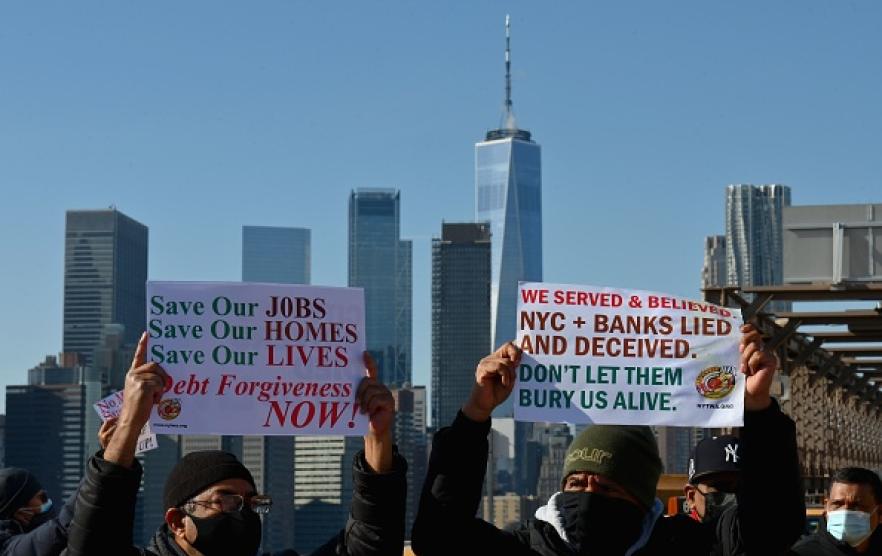
Debt collectors file millions of lawsuits every year- many of them pitting seasoned attorneys against ordinary people who struggle to get a fair hearing in court.

Justice Index

The Justice Index is a snapshot of how well each state does in securing access to justice for some of our most vulnerable populations. View our detailed maps, data and state-by-state rankings.

Latest news

Jaquez Proposed Amicus Brief
This past week, NCAJ co-authored with WilmerHale a proposed amicus brief in Matter of Jaquez v. Tietz on behalf of NCAJ and two fellow amici. The brief urges New York's highest court to preserve the “catalyst theory” under New York's Equal Access to Justice Act (EAJA). Under the catalyst theory, a party may claim and recover attorneys’ fees under EAJA when the filing of a lawsuit serves as the catalyst that prompts the government to correct an agency error before a court reaches and decides the case on the merits. Catalyst fees are critical to EAJA's purpose because, without them, the government could avoid fee liability by correcting its error after a suit is filed, making lawyers less likely to take similar cases in the future. The amicus brief further explains that the value of representation is not only access, but also what access accomplishes: correction of the government's errors of law, and creation of incentives to reduce such errors by government in future cases. In these ways, the brief highlights the importance of catalyst fees in promoting the rule of law.
AI & AtJ
Tens of millions of civil legal problems go unaddressed each year in the United States, while AI technologies are rapidly finding applications across virtually every domain of human endeavor. In this high velocity moment, the conference will examine how AI is being summoned to close the civil justice gap. Scholars, practitioners, reformers, and technologists will convene for public conversation and debate around three core questions: What is the access to justice movement? What is the potential of emerging AI technologies to address the civil justice crisis? And what safeguards should shape increased reliance on proposed AI solutions?
International AtJ Forum
The International Access to Justice Forum 2025 will be taking place on September 26th and September 27th, 2025, bringing together almost 300 members of the access to justice community from more than 20 countries including Argentina, Australia, Austria, Bangladesh, Brazil, Canada, Chile, El Salvador, Ethiopia, Ghana, Honduras, India, Italy, Mali, Mexico, Netherlands, Nigeria, Pakistan, Paraguay, Poland, Portugal, United Kingdom, United States and Zimbabwe.
Ferguson image
On June 2, 2025, NCAJ and the Stein Center for Law and Ethics convened at Fordham Law a group of 25 experts for Innovation Day on Ability to Pay -- a day of dialogue on how to use research to better understand and improve the policies that guide judges in making determinations on people's ability to pay government-imposed fines and fees. NCAJ had earlier collected and described examples of such policies in the Ability to Pay Report and the Fines and Fees Justice Index.
International AtJ Forum
We are excited to announce the 2025 International Access to Justice Forum will be held in New York City on September 26th and September 27th, 2025, hosted by Fordham & NYU Law Schools, including the National Center for Access to Justice. This international event has been at the center of the creative advocacy and scholarship around Access to Justice, and we are looking forward to continuing that tradition.
Cover of NCAJ's Symposium Foreword
In eight new articles arising out of the Access to Justice Solutions Symposium, the public event hosted by NCAJ on February 9, 2024 in partnership with the Stein Center for Law & Ethics and Fordham's Urban Law Journal, scholars and advocates now discuss and analyze important policy solutions at the leading edge of the access to justice movement.
Support Our Work